
 English
  Tiếng Việt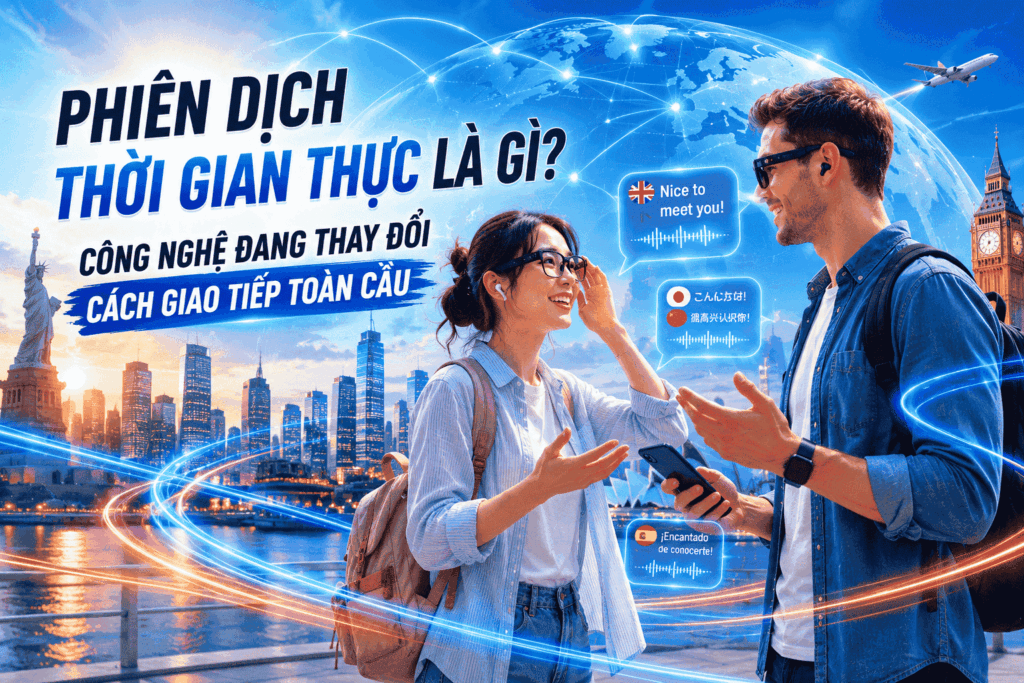
Real-time translation is becoming one of the most talked-about technologies in the era of globalization. As people become increasingly connected through international travel, commerce, study, and work, language barriers remain one of the biggest challenges.
Not everyone has the time to learn multiple foreign languages. Many people encounter difficulties during airport procedures, international meetings, communication with foreign partners, or simply asking for directions while traveling. For the elderly, settlers, or foreign workers, communicating in a different language can also become a daily pressure.
The development of AI technology has created a major breakthrough in the field of translation. Today, smart translation devices can assist users in communicating almost instantly in various languages. This is the foundation of real-time translation technology.


What is real-time translation?
Real-time translation is a technology that uses artificial intelligence to recognize speech, process language, and convert content into another language almost instantly. Instead of waiting for manual translation or typing content into an application, users can simply speak normally. The system performs the following steps:- Speech recognition
- Speech-to-text conversion.
- Translation of content into the target language.
- Display or playback of the translation.
How does real-time translation work?
Behind this convenience are many modern technologies. A real-time translation system typically includes: Speech recognition The device captures audio from the speaker. AI analyzes the speech and converts it into text. Natural Language Processing After recognizing the content, the system analyzes the context. This makes the translation more natural and reduces machine translation errors. AI-powered Translation Language models convert the content into the target language. Display or Audio Output The translation can be displayed on a phone screen, smart glasses, or played directly through headphones.
Benefits of real-time translation in modern life
This technology is changing how people communicate around the world. Some prominent benefits include: Breaking down language barriers Users can communicate with foreigners without needing to be fluent in a foreign language. Increasing work efficiency Businesses can work with international partners more easily. Supporting travel Tourists can ask for directions, shop, or communicate with locals more conveniently. Supporting education International students can access knowledge from various language sources. Supporting the elderly Those who do not know foreign languages can confidently communicate when traveling abroad.How is real-time translation changing global communication?
Previously, international meetings often required professional interpreters. Today, many businesses use AI translation devices to facilitate communication. This helps to:- Reduce costs.
- Save time.
- Speed up information exchange.
- Expand international cooperation opportunities.
Featured products applying real-time translation technology
If you want to experience modern translation technology, you can refer to the following devices: Timekeco X1 AI Interpreter Hub The premium translation device for businesses and international conferences. Supports multiple languages and multiple participants simultaneously. >>> Learn more at: Timekettle X1 AI Interpreter Hub Professional Translator Suitable for: Real-time translation earbuds supporting two-way communication. Suitable for frequent business travelers or those traveling abroad. >>> Learn more at: New generation Timek222ettle W4 Pro translation earbuds INMO AIR3 Smart translation glasses display translated content directly in the user's field of vision. >>> View more at: INMO Air 3 Translation Glasses Rokid Glasses Style AI glasses integrate multiple smart features and support multilingual communication. >>> Learn more at: Rokid AI Glasses Translator Vtalk AI Ear Compact translation earbuds, suitable for beginners using AI translation technology. >> Learn more at: Vtalk AI Ear high-end translation earbuds at a good price All products are currently available at Sahaha Hanoi Shop and Sahaha Ho Chi Minh Shop<strong>Outstanding Features of Vtalk AI Ear Translation Headset</strong><b data-path-to-node="11" data-index-in-node="0">Integrated AI translation algorithms</b> for detailed answers.Where is real-time translation used?
Currently, this technology appears in many fields. International Travel Supports communication with local people. Logistics and Import-Export Helps employees work more effectively with foreign partners. Healthcare Supports communication between doctors and patients of different languages. Education Increase access to global knowledge. International Conference Help more people from different countries communicate more effectively.
Can real-time translation completely replace human interpreters?
This is a question many people are asking. The answer is not yet. Although AI is developing very rapidly, there are still some limitations. For example:- Complex technical jargon.
- Local idioms.
- Special cultural contexts.
- High-level negotiations.
The future of real-time translation technology
In the coming years, AI will continue to improve its translation capabilities. Key trends include:- More accurate translation.
- Support for more languages.
- Faster response speed.
- More compact devices.
- Deeper integration into smart glasses and wearable devices.